



Isn’t The World Round? The shape of the Earth is a fascinating and intricate topic. Modern science and observations have provided us with a comprehensive understanding of the Earth’s shape.
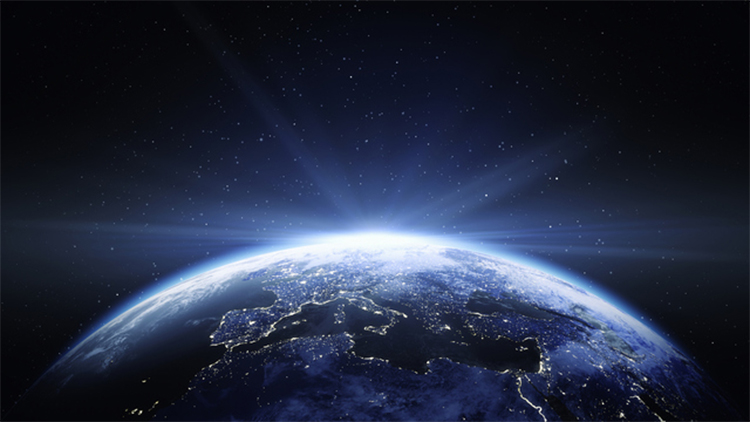
1.What is Geoid?
Geoid refers to a surface where the Earth‘s gravitational field is irregular due to surface instabilities. The Earth’s surface is formed as a geoid, not a uniform sphere, due to oceans, mountains, valleys, and other topographic features. This shows that the effect of gravity is not uniform on the surface.
2. Surface Irregularities:
The Earth’s surface is marked by a complex and varied landscape, including oceans, mountains, valleys, and continents. These irregularities cause the Earth’s shape to deviate from a perfect sphere. The presence of massive mountain ranges, for instance, creates localized gravitational variations.
3. Equator and Poles:
The equator, the largest circumferential line on Earth, divides it into two nearly equal hemispheres. However, due to the Earth’s oblate shape, the diameters measured along the equator are slightly longer than those measured from pole to pole.
- Advertisement -
4. Geoidal Shape:
This geoid shape of the Earth is a result of the distortion effect being balanced by surface instabilities. This means that the Earth’s surface is complex and variable.
5. Determining the Shape:
Measuring the shape of the Earth involves complex geodetic calculations and satellite-based observations. Techniques such as satellite laser ranging, very-long-baseline interferometry (VLBI), and satellite gravimetry have been employed to precisely determine the Earth’s shape and monitor changes over time.
6. Maps and Geographic Information Systems:
The shape of the Earth is a key factor in producing maps and their resulting information (GIS). Earth’s geoid shape is taken in map projections and unit coordinate measurements measurements
7.Geoidal Shape: :
The gravitational forces between the Earth’s core and its surface are balanced in the shape of the geoid. This means that the Earth’s surface is complex and variable.
8. Spheroid Models:
For many practical purposes, the Earth is approximated as an oblate spheroid or ellipsoid.
Isn’t The World Round? This geoid shape of the Earth is better understood with modern technology and scientific research.
Click for more information!



