



The first theoretical discovery of black holes dates back to Albert Einstein’s publication of his general theory of relativity in 1915. General relativity proposes that space-time is curved by the presence of mass. That this curvature determines the motion between masses. This theory defines the concept of gravity in a different way than previous ones. Explains the curvature of space-time and the paths of objects within the warped space-time.
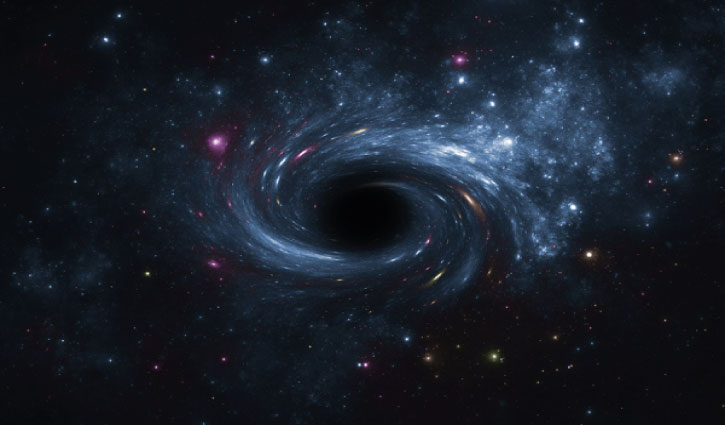
The Mystery Of Black Holes:
- Unknown Content: The contents inside remain a significant mystery. However, this concept clashes with quantum mechanics. Making it difficult to understand what exists within a black hole.
- Singularity: The singularity at the center of a black hole presents a perplexing challenge to physicists. It defies our current understanding of physics. Laws of physics break down in such extreme conditions. Understanding and characterizing the singularity is one of the central goals in black hole research.
- Information Paradox: The fate of information that falls into a black hole. Known as the “information paradox,” is another enigma. Quantum mechanics dictates that information cannot be destroyed. Yet general relativity suggests that information entering a black hole may be lost forever. Resolving this paradox is crucial for a complete understanding of black holes.
- Evolution of Black Holes: The formation, growth. Eventual fate of are still areas of active investigation. Understanding how accrete matter, interact with their surroundings.
Discovery and Early Emergence of Black Holes
- Theoretical Developments: The initial discovery of black holes is often rooted in Albert Einstein’s theory of general relativity. Published in 1915, Einstein’s theory links gravity to the curvature of spacetime. Earlier scientists like John Michell and Pierre-Simon Laplace had suggested. Gravity could be so intense as to capture everything, including light.
- Introduction of the Term “Black Hole”: However, the modern concept of a “black hole” is largely attributed to a solution proposed by Karl Schwarzschild in 1916. Schwarzschild theorized that a star of a certain density and mass could collapse into a black hole.
- Physical Observations: The existence of was initially confirmed through X-ray observations. In the late 1960s, X-ray observations revealed the presence of high-energy objects outside the Solar System. These objects, absorbing electromagnetic radiation. Were classified as due to their immense gravitational pull.
Nature and Characteristics of Black Holes
- Definition and Features: Black holes are astronomical objects where space-time is so strongly curved that even light cannot escape from their gravitational pull, known as the “event horizon.” They are characterized by their density and gravitational effects.
- Types: Are typically categorized into two main types: rotating and non-rotating. Rotating can generate an accretion disk, a spinning disk of matter surrounding them. Supermassive black holes are enormous with billions of solar masses. Often found at the centers of galaxies.
Remain one of the most mysterious. Intriguing phenomena in the universe, continuing to captivate researchers in the fields of astronomy, astrophysics, and theoretical physics.
Click For More Information!!